

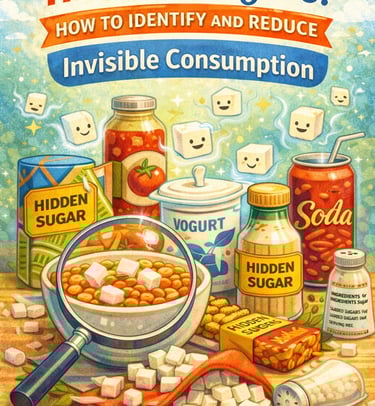
Hidden Sugars: How to Identify and Reduce Invisible Consumption
Discover where the sugar sabotaging your health is hiding
1/7/202610 min read
Hidden Sugars: How to Identify and Reduce Invisible Consumption
Discover where the sugar sabotaging your health is hiding
Do you believe you don't consume much sugar because you avoid desserts and don't sweeten your coffee? Unfortunately, reality may be quite different. Sugar is hidden in surprising places: in tomato sauce, in whole grain bread, in restaurant Caesar salads, and even in that "healthy" granola bar.
The World Health Organization recommends that free sugar consumption not exceed 10% of total daily calories, ideally staying below 5%. For a 2000-calorie diet, this means a maximum of 50g of sugar per day, ideally 25g. A simple 12 oz (350ml) soda already contains about 37g.
The problem is that the food industry uses over 60 different names for sugar, making it difficult to identify on labels. In this complete guide, you'll learn to decipher labels, identify hidden sugars, and make smart substitutions to drastically reduce your consumption without sacrificing flavor.
Why Is Excess Sugar Harmful?
Before learning to identify hidden sugars, it's important to understand why this matters.
Health Impacts
Weight gain and obesity: Sugar provides empty calories without satiety, easily leading to caloric excess. Additionally, excess fructose is metabolized primarily in the liver, favoring fat accumulation.
Insulin resistance and type 2 diabetes: Constant glucose spikes overburden the pancreas and, over time, cells become less responsive to insulin.
Cardiovascular diseases: Studies associate high sugar consumption with elevated triglycerides, high blood pressure, and chronic inflammation—cardiovascular risk factors.
Dental health: Oral bacteria feed on sugar, producing acids that corrode tooth enamel.
Chronic inflammation: Excess sugar can promote systemic inflammation, related to various chronic conditions.
Dependence and compulsion: Sugar activates the same reward circuits in the brain as addictive substances, potentially leading to compulsive consumption patterns.
Premature aging: Excess glucose can bind to proteins in a process called glycation, accelerating cellular aging.
The 60+ Names of Sugar
The food industry uses various names for sugar, making identification difficult. Here's a comprehensive list:
Obvious Sugars
Sugar
Brown sugar
Raw sugar
Cane sugar
Coconut sugar
Invert sugar
Turbinado sugar
Confectioners' sugar
Syrups
Corn syrup
High fructose corn syrup (HFCS)
Glucose syrup
Agave syrup/nectar
Rice syrup
Malt syrup
Maple syrup
Corn syrup solids
Golden syrup
Endings in "-ose"
Sucrose
Fructose
Glucose
Dextrose
Maltose
Lactose
Galactose
Molasses and Honey
Molasses
Blackstrap molasses
Honey
Agave nectar
Date syrup
Other Disguises
Malt
Maltodextrin
Dextrin
Malt extract
Fruit juice concentrate
Fruit puree
Evaporated cane juice
Beet sugar
Caramel
Carob
Cane juice crystals
Date sugar
Grape sugar
Diastase
Ethyl maltol
Glucose solids
Mannitol
Sorbitol
Xylitol
Erythritol
How to Identify on Labels
Ingredients are listed in descending order by quantity. If you see 3, 4, or more types of sugar on the list, even if separated, the product probably has lots of total sugar.
Real example: A breakfast cereal might list: wheat flour, sugar, corn syrup, honey, maltodextrin. That's 4 types of disguised sugar!
Where Sugar Hides
Sauces and Condiments
Ketchup: 1 tablespoon can contain 4g of sugar (1 teaspoon).
Salad dressings: Creamy and sweet dressings can have 3-5g per serving.
Industrial tomato sauce: One cup can have up to 12g added sugar.
Teriyaki sauce: Up to 15g per ¼ cup serving.
BBQ sauce: 6-12g per 2 tablespoons.
Sweet and sour sauce: One of the worst, with up to 20g per small serving.
Breads and Bakery Products
Whole wheat bread: 2-4g per slice (yes, even whole wheat!).
Hamburger buns: 3-5g per unit.
Hot dog buns: Similar to hamburger buns.
Croissants and puff pastries: 5-8g per unit.
Sweet rolls: 6-10g per unit.
Beverages
Sodas: 35-40g per 12 oz (350ml) can.
Industrial juices: 20-30g per 7 oz (200ml) glass, even "100% fruit."
Ready-made teas: 15-25g per bottle.
Energy drinks: 25-35g per can.
Industrial coconut water: Some brands add sugar, reaching 10-15g.
Sweetened plant milks: 5-15g per glass.
Ready-made flavored coffee: 15-25g per serving.
Yogurts and Dairy
Flavored yogurt: 15-25g per 6 oz (170g) container (more than a donut!).
Sweetened Greek yogurt: 10-18g per serving.
Dairy drinks: 20-30g per box.
Cottage cheese with fruit: 10-15g per serving.
Cereals and Bars
Breakfast cereals: 8-15g per serving (about ¾ cup).
Industrial granola: 10-15g per ½ cup.
Granola bars: 6-12g per unit (sometimes more than a filled cookie!).
Protein bars: 10-20g in some versions.
Flavored instant oatmeal: 10-15g per packet.
"Healthy" Foods
Dried fruits: Many have added sugar beyond natural. A serving can have 20-30g.
Diet jams and preserves: Even "sugar-free" ones may use fruit juice concentrate.
Peanut/nut butters: Industrial versions can have 3-5g per tablespoon.
Frozen ready meals: Lasagnas, pizzas, and ready meals frequently have sugar.
Industrial soups: 3-8g per serving, especially tomato.
Ready-made seasonings: Broths and complete seasonings may contain sugar.
Children's Foods
Ready-made baby food: 5-10g per jar.
Chocolate milk powder: 10-15g per serving.
Boxed juices for kids: 15-20g per 7 oz (200ml) box.
Yogurt tubes: 10-15g per unit.
Children's cookies: 3-5g per unit.
How to Read Labels Correctly
Nutrition Facts Table
Look for the "Carbohydrates" line and then "of which sugars." This value includes natural sugars (like lactose from milk or fructose from fruits) and added sugars.
Important tip: Plain yogurt without sugar will have about 5-6g of sugar (natural lactose). Everything above that is added sugar. Yogurt with 20g means about 14-15g of added sugar.
Ingredient List
Read carefully. If sugar (any of the 60+ names) appears in the first 3 ingredients, the product has lots of sugar.
If multiple types of sugar appear throughout the list, mentally add them up: the product probably has lots of total sugar.
Misleading Claims
"No added sugar": May have fruit juice concentrate, which is basically sugar.
"Light" or "Reduced sugar": May still have significant amount. Compare with original.
"Natural": Doesn't mean sugar-free. Honey, coconut sugar, and agave syrup are natural but still sugar.
"Whole grain" or "High in fiber": Doesn't guarantee low sugar. Many whole wheat breads have added sugar.
"Energy source": Common euphemism for "high in sugar."
Strategies to Reduce Hidden Sugars
1. Prioritize Real Foods
The closer to natural state, the less added sugar. An apple will never have added sugar, an industrial apple juice probably will.
2. Cook More at Home
When you prepare, you control exactly what goes in. Homemade tomato sauce, homemade granola, homemade bread—all can be made without or with much less sugar.
3. Make Smart Substitutions
Instead of Choose Flavored yogurt Plain yogurt + fresh fruit Industrial juice Water with fruit slices or unsweetened iced tea Sugary breakfast cereal Oatmeal with fruit and cinnamon Industrial granola bar Mix of nuts and unsweetened dried fruit Ready-made salad dressing Olive oil, vinegar/lemon, herbs and spices Industrial ketchup Homemade tomato sauce or mustard Industrial granola Homemade granola with less honey/sugar
4. Dilute Sweet Drinks
If you can't stop juices completely, dilute 50% with water or sparkling water. Gradually increase dilution.
5. Retrain Your Palate
Our palate adapts. Gradually reduce sugar and, in 2-3 weeks, you'll find foods you liked before "too sweet." Start by reducing 25%, then 50%, and so on.
Homemade Substitution Recipes
Sugar-Free Tomato Sauce
Ingredients:
2.2 lbs (1kg) ripe tomatoes
3 garlic cloves
1 medium onion
Fresh basil
Olive oil, salt, black pepper
1 small grated carrot (naturally sweetens without adding sugar)
Preparation: Sauté onion and garlic in olive oil. Add chopped tomatoes, grated carrot, and seasonings. Cook for 30-40 minutes over low heat until thickened. Blend if you prefer smoother texture. Carrot naturally sweetens, balancing tomato acidity.
Low-Sugar Homemade Granola
Ingredients:
3 cups rolled oats
1 cup chopped nuts (cashews, almonds, walnuts)
½ cup seeds (sunflower, pumpkin, sesame)
¼ cup coconut oil
3 tablespoons honey or maple syrup (much less than industrial)
1 teaspoon cinnamon
1 teaspoon vanilla extract
Pinch of salt
Preparation: Mix all dry ingredients. Heat coconut oil with honey until melted, add vanilla. Pour over dry mixture and stir well. Spread on baking sheet and bake at 320°F (160°C) for 25-30 minutes, stirring halfway. Let cool completely (becomes crunchy). Store in airtight container.
Sugar per serving: About 3g (vs. 10-15g industrial)
Homemade Granola Bars
Ingredients:
2 cups rolled oats
½ cup date paste (dates blended with little water)
¼ cup sugar-free peanut butter
½ cup chopped nuts
2 tablespoons chia seeds
1 teaspoon vanilla extract
Pinch of salt
Preparation: Mix date paste with peanut butter and vanilla. Add dry ingredients and mix well (use hands if necessary). Press firmly into pan lined with parchment paper. Refrigerate for 2 hours. Cut into bars. Store in refrigerator.
Advantage: Sweetened only with dates (natural sugar with fiber) and contains protein and healthy fats for satiety.
Homemade Ketchup
Ingredients:
1 can tomato paste (12 oz/340g)
3 tablespoons apple cider vinegar
1 tablespoon honey or molasses (optional and reduced)
1 teaspoon onion powder
½ teaspoon garlic powder
Pinch of cloves, cinnamon, and pepper
Salt to taste
Preparation: Mix all ingredients in pot. Cook over low heat for 10 minutes, stirring occasionally. Adjust seasonings. Let cool and store in refrigerator for up to 2 weeks.
Sugar per tablespoon: Less than 1g (vs. 4g industrial)
Homemade Chocolate Milk Powder
Ingredients:
½ cup 100% cocoa powder
2-3 tablespoons coconut or demerara sugar (adjust to taste)
Pinch of salt
Optional: pinch of cinnamon or vanilla powder
Preparation: Mix all ingredients. Store in airtight container. Use 1-2 teaspoons per glass of milk.
Advantage: You control sugar amount. Start with less and increase only if necessary.
Versatile Salad Dressing
Base ingredients:
3 parts olive oil
1 part acid (vinegar or lemon)
1 teaspoon Dijon mustard
Salt, pepper, fresh herbs
Sugar-free variations:
Italian: add oregano, basil, and garlic
French: add tarragon and shallots
Balsamic: use balsamic vinegar and garlic
Asian: add ginger, garlic, touch of soy sauce
Tip: If you need to sweeten slightly, use ½ teaspoon honey for entire recipe, not industrial quantities in ready-made dressings.
4-Week Gradual Reduction Plan
Week 1: Awareness
Read all labels of products you consume
Note which have hidden sugar
Don't change anything yet, just observe
Week 2: First Substitutions
Replace sodas with sparkling water and lemon
Swap flavored yogurts for plain with fruit
Eliminate added sugar in coffee/tea (or reduce by half)
Week 3: Sauces and Condiments
Make homemade ketchup and tomato sauce
Prepare salad dressings at home
Reduce industrial sauce use by half
Week 4: Breakfast and Snacks
Replace sugary cereals with oatmeal
Swap industrial bars for nut mix
Prepare homemade granola
After 4 weeks: Your palate will already be more sensitive to sweetness. Continue making substitutions gradually.
Natural Sugars: Still Need Moderation
It's important to understand that sugars naturally present in whole foods (fruits, milk) come with fiber, protein, vitamins, and minerals, making their glycemic impact lower.
Sugar Hierarchy (Best to Worst)
Best: Whole fruits (with fiber that slows absorption)
Good: Dates, dried fruits without added sugar (in moderation due to concentration)
Acceptable in moderation: Honey, molasses, coconut sugar, maple syrup (have trace nutrients but still concentrated sugar)
Avoid: White sugar, refined sugar, corn syrup, high fructose corn syrup
Worst: Sugars in beverages (ultra-fast absorption, zero satiety)
Artificial Sweeteners: Solution or Problem?
Sweeteners like aspartame, sucralose, saccharin, and acesulfame-K don't raise blood sugar, but there are debates about their effects:
Possible disadvantages:
May maintain desire for sweetness
Some studies suggest impact on gut microbiome
May confuse body's metabolic response
Possible advantages:
Useful in transition to reduce sugar
Don't cause cavities
Don't raise blood sugar
Recommendation: Use in moderation as transition tool, not permanent solution. Final goal is retraining palate to appreciate less sweetness.
Social Situations and Challenges
Restaurants
Ask for sauces and dressings on the side
Choose simple preparations (grilled, baked) instead of processed
Prefer water, sparkling water, or unsweetened tea
Travel
Bring homemade snacks (nuts, fruits)
Look for local markets instead of only convenience stores
Stay hydrated (sometimes we confuse thirst with hunger)
Parties and Events
Don't need to be radical: choose ONE dessert that's really worth it
Eat balanced meal before so you don't arrive starving
Focus on conversations, not food
Dealing with Family
Make changes gradually to not generate resistance
Involve everyone in preparing homemade versions
Don't use food as reward or punishment
Be example, not food police
Benefits of Reducing Hidden Sugars
After 30-60 days reducing hidden sugars, you may notice:
More stable energy throughout day, without peaks and crashes
Less food cravings, especially for sweets
Improved sleep quality
Clearer skin with less inflammation
Reduced bloating and fluid retention
Weight loss (if that's your goal)
More sensitive palate, appreciating natural food flavors
More stable mood, less irritability
Better digestion and bowel function
Checklist: Are You on the Right Track?
✓ I read labels regularly and recognize various sugar names ✓ I replaced sodas and juices with water or sugar-free alternatives ✓ I consume plain yogurt instead of flavored ✓ I prepare homemade sauces or choose sugar-free versions ✓ I choose cereals and breads with less than 5g sugar per serving ✓ I snack on real foods (fruits, nuts) instead of processed ✓ I cook more at home, controlling ingredients ✓ My palate is less tolerant of excessive sweetness ✓ I don't regularly use sweet food as emotional reward ✓ I allow myself occasional desserts without guilt, but consciously
Conclusion: Knowledge Is Liberation
Identifying hidden sugars isn't about obsession or living in extreme restriction. It's about making informed and conscious choices. When you know what you're consuming, you regain control over your eating and your health.
Start small: choose ONE category (beverages, yogurts, sauces) and make the substitution. When that change is incorporated, move to the next. Gradual and sustainable changes are always better than radical transformations that last two weeks.
Remember: the goal isn't to completely eliminate the pleasure of eating an occasional sweet. It's to reduce unnecessary sugar hiding where you never imagined, so when you choose to eat something sweet, it's a conscious choice that's truly worth it.
Your body and your long-term health thank you for every small change you make today.
📋 Quick Reference: Hidden Sugar Spotter
🔍 The 60+ Names Cheat Sheet
Print this and take it shopping!
Obviously Sweet: Sugar, Brown Sugar, Cane Sugar, Coconut Sugar, Raw Sugar
Syrup Family: Corn Syrup, HFCS, Agave, Maple, Rice Syrup, Malt Syrup, Golden Syrup
"-ose" Endings: Sucrose, Fructose, Glucose, Dextrose, Maltose, Lactose
Sneaky Names: Maltodextrin, Dextrin, Malt Extract, Fruit Juice Concentrate, Evaporated Cane Juice, Cane Juice Crystals
"Natural" Disguises: Honey, Molasses, Date Sugar, Grape Sugar, Agave Nectar
Sugar Alcohols: Sorbitol, Mannitol, Xylitol, Erythritol
🚨 Biggest Offenders (Sugar per Serving)
Food Serving Sugar Soda 12 oz can 35-40g Flavored Yogurt 6 oz 15-25g Granola Bar 1 bar 6-12g Ketchup 1 tbsp 4g BBQ Sauce 2 tbsp 6-12g Boxed Juice 7 oz 20-30g Cereal ¾ cup 8-15g Energy Drink 1 can 25-35g
📊 Daily Sugar Limits (WHO Guidelines)
Calories/Day Max Sugar (10%) Ideal (5%) 1500 37g 19g 2000 50g 25g 2500 62g 31g
Visual: 1 teaspoon sugar = 4g
✅ Smart Swaps
❌ Instead of ✅ Choose Flavored yogurt (20g) Plain yogurt + berries (6g) Boxed juice (25g) Fruit-infused water (0g) Granola bar (10g) Nut mix + dates (5g natural) BBQ sauce (10g) Mustard + spices (0g) Sweetened oatmeal (12g) Plain oats + cinnamon + banana (0g added) Chocolate milk powder (12g) Unsweetened cocoa + small honey (3g)
🍳 Easy Homemade Alternatives
10-Minute Recipes:
Tomato Sauce: Tomatoes + garlic + carrot (natural sweetener)
Salad Dressing: Olive oil + vinegar + mustard + herbs
Ketchup: Tomato paste + vinegar + spices
Chocolate Milk: Cocoa + milk + small honey
Weekend Batch Prep:
Granola: Oats + nuts + 3 tbsp honey (vs 15g per serving store-bought)
Granola Bars: Dates + oats + nut butter (no added sugar)
Overnight Oats: Prep 5 jars for the week
🔬 Reading Labels Like a Pro
Red Flags:
Sugar in first 3 ingredients
Multiple types of sugar throughout list
"Natural flavors" + any sugar name
More than 10g sugar per serving (non-fruit foods)
Green Lights:
No sugar names in first 5 ingredients
Less than 5g sugar per serving
Short ingredient list (under 10 items)
Recognizable food words
The Math Trick: Plain yogurt = 5-6g natural sugar (lactose) Your yogurt = 18g total sugar Added sugar = 12-13g ⚠️
📅 4-Week Sugar Detox Plan
Week 1: Read every label, identify hidden sugars Week 2: Cut sweetened drinks (save 20-40g/day) Week 3: Replace sauces/condiments (save 5-10g/day) Week 4: Fix breakfast/snacks (save 10-15g/day)
Total savings: 35-65g sugar/day!
🎯 Progressive Palate Reset
Days 1-7: Reduce by 25%
Notice sweetness more
Days 8-14: Reduce by 50%
Old favorites taste too sweet
Days 15-21: Reduce by 75%
Natural sweetness appreciated
Days 22-30: Minimal added sugar
Reset complete!
💪 Benefits Timeline
Week 1:
More stable energy
Less crashes
Week 2:
Reduced cravings
Better sleep
Week 3:
Clearer skin
Less bloating
Week 4:
Palate reset
Natural sweetness tastes amazing
Month 2+:
Weight loss (if needed)
Improved metabolic markers
Long-term health benefits
🏪 Shopping Strategy
Outer aisles = better
Produce, meat, dairy (plain)
Minimal processing
Inner aisles = danger zone
Read every label
Beware "health" claims
Red flag words:
"Natural"
"Organic" (doesn't mean sugar-free!)
"Healthy"
"Fit"
"Energy"
🎓 Pro Tips from Nutritionists
"If you can't pronounce it, it's probably sugar"
"Multiple sugars = sugar bomb in disguise"
"Plain + fruit = always better than flavored"
"Cook once, control forever"
"Your palate needs 3 weeks to reset"
"Save sugar for desserts, not for dinner"
Final tip: Print the 60+ sugar names list and take it shopping for your first trips. Soon, you'll automatically recognize disguises on labels.
Tags: hidden sugars, sugar in foods, how to read food labels, reduce sugar intake, sugar detox, added sugar, sugar-free alternatives, healthy eating, nutrition labels, processed foods, sugar names, whole foods diet
Disclaimer: This article is for informational purposes. For personalized guidance, especially if you have specific health conditions, consult a nutritionist or physician.